
Your child manages the entire school day without incident. The teacher reports they followed instructions, completed their work, and stayed reasonably regulated in the classroom.
Then they walk through the front door.
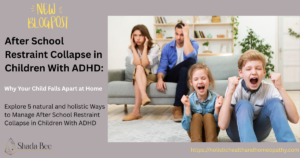
Within minutes, tears emerge. They become irritable, argumentative, restless, or completely inconsolable. A simple question like “How was your day?” triggers frustration. Their sibling says something minor and the afternoon dissolves into emotional meltdown.
For many parents, this pattern is bewildering: How can my child manage so well at school but completely unravel at home?
This experience is called after school restraint collapse, and it is one of the most common challenges families of children with ADHD encounter.
What Is After School Restraint Collapse?
After school restraint collapse happens when a child spends most of the day managing emotions, behavior, attention, and impulses in a structured environment. By the time they arrive home, that capacity is completely exhausted.
School demands constant effort from children with ADHD:
They sit still when their body wants to move. They listen to instructions while filtering out background noise. They remember transitions between activities and complete tasks. They navigate friendships and control impulsive reactions.
For children with ADHD, maintaining this control requires enormous mental energy. The child may appear calm at school because they are working very hard to stay regulated. That effort comes at a cost.
Home is where the child feels safest. It is also where everything they have been holding in finally comes out.
What Does After School Restraint Collapse Look Like?
The behavior pattern varies significantly from child to child.
One child may come home angry and argumentative. Another cries over something trivial. Some become extremely silly, loud, or physically restless. Others need complete silence and cannot tolerate conversation.
A child exhibiting after school restraint collapse may:
Become suddenly hungry, sensitive to noise, clingy, or impatient. Become completely exhausted despite “just” sitting at school. Find homework almost impossible to approach. Direct frustration at siblings over small provocation. Feel overwhelmed by simple requests like changing clothes or putting away a backpack.
The behavior can appear dramatic or out of proportion. That intensity is often the child showing you they have reached their regulation limit.
Understanding what drives the behavior makes response more effective.
Why Children With ADHD Experience More Pronounced Restraint Collapse
Children with ADHD expend significantly more energy than most realize trying to function in a structured classroom.
A typical school day requires:
Sustained attention in spite of internal and external distractions. Executive function tasks like organizing materials and remembering multi-step instructions. Impulse control during transitions and social interaction. Filtering out sensory input (noise, movement, visual distraction) while maintaining focus.
A child with ADHD may be:
Working to focus while their brain registers every sound and movement in the room. Reminding themselves not to interrupt or blurt out comments. Holding multiple instructions in working memory simultaneously. Managing frustration that schoolwork takes more effort than it seems to take peers. Navigating social pressure and the feeling of always working twice as hard just to keep up.
By afternoon, the child has very little left to give.
This explains why the child who appears competent at school can completely fall apart once home.
How Homeopathy Approaches After School Restraint Collapse
In homeopathy for ADHD, I do not consider the ADHD diagnosis as the starting point. I focus on understanding the individual child.
The key questions are:
How does this particular child react when overwhelmed? Do they become angry and impatient? Do they cry and seek comfort? Do they become physically restless or tense? Do they become hypersensitive to noise and touch? Do they need isolation? Does hunger intensify their reaction?
These differences matter profoundly.
Two children can both have ADHD and respond to the school day in completely opposite ways. The homeopathic remedy is selected based on the whole pattern: emotional reactions, sleep quality, digestion, sensory sensitivities, fears, food preferences, energy patterns, and what makes symptoms better or worse.
There is no single remedy for after school restraint collapse, but several remedies may be considered depending on the child’s complete picture.
Homeopathic Remedies for After School Behavior
Coffea Cruda for Overstimulation and Racing Mind
Coffea may be indicated when the child seems completely overstimulated and unable to downshift mentally.
The child may arrive home talking constantly, jumping from one activity to another, appearing even more energetic despite physical tiredness. Their mind remains very active. They may have difficulty settling in the evening.
This is often the child who becomes increasingly “wired” as the day progresses, as if their nervous system cannot find the off switch.
Nux Vomica for Irritability and Overwhelm
Nux vomica may help when the child becomes irritable, impatient, and easily overwhelmed by minor demands.
Noise feels unbearable. Questions feel irritating. The child may snap at family members or react strongly to one additional request.
Associated patterns often include digestive complaints, sensitivity to certain foods, or symptoms that worsen when tired or overstimulated.
Chamomilla for Extreme Reactivity
Chamomilla may be indicated when the child is extremely reactive and difficult to soothe.
Small frustrations produce disproportionately large responses. The child becomes angry quickly and seems impossible to please. They may request something and immediately reject it.
There is a strong sense that everything is bothering them simultaneously.
Pulsatilla for Emotional Sensitivity and Need for Connection
Pulsatilla presents quite differently from the above remedies.
The child may come home tearful, emotionally sensitive, and craving comfort. They need reassurance, affection, and closeness. They want to talk about their day or simply sit beside a parent for support.
This child does not become explosive. Instead, the day’s stress emerges as tears, sensitivity, and a strong need for emotional connection.
Remedy selection should always be based on the child’s complete pattern, not on a single symptom.
Cell Salts for Nervous Exhaustion and Mental Fatigue
Cell salts offer gentle support when the child appears mentally and emotionally depleted after school.
Kali Phosphoricum for Mental Fatigue
Kali phosphoricum is useful when the child seems mentally exhausted from concentration and school demands. The child appears mentally tired, irritable, and unable to handle further stimulation by day’s end.
Magnesia Phosphorica for Physical Nervous Tension
Magnesia phosphorica may be considered when nervous tension manifests physically. The child seems tense, restless, or physically uncomfortable and may carry stress throughout the body.
Calcarea Phosphorica for Growing Children
Calcarea phosphorica supports growing children who tire easily from mental effort and school demands.
As with homeopathic remedies, I prefer selecting cell salts according to the individual child rather than giving multiple supplements at once.
The Critical First 30 Minutes After School
One simple change parents can make is to provide a transition period rather than jumping directly into demands.
Many children come through the door and immediately encounter questions:
“How was school?” “Do you have homework?” “Did you finish your assignment?” “Why is your lunch still in your backpack?” “Can you go change your clothes?”
These are normal parental questions. But for a child already depleted from managing demands for hours, they register as one more thing to handle.
Sometimes the first 20 to 30 minutes after school need to be very simple.
Offer food and water. Give the child time to settle without interrogation. Provide quiet if they need it. Allow movement if their body needs it.
Notice what your individual child needs:
One child may need to run outside to burn energy. Another needs to sit quietly without conversation. Another wants to sit beside you and narrate their entire day.
The goal is identifying what helps your child return to balance. That becomes your afternoon routine.
Setting Boundaries While Understanding Restraint Collapse
Understanding after school restraint collapse does not eliminate the need for boundaries and guidance.
A child still needs to learn that hitting, yelling at family members, or breaking things is unacceptable.
The timing of correction matters significantly.
When the child is in active meltdown, their nervous system cannot process a lengthy explanation or lesson. Their ability to learn is offline.
Help them calm first. Once they are regulated, return to what happened and set a clear boundary.
A response might be: “I know you are overwhelmed, but you cannot hit your brother. We will talk about this when you are calmer.”
This acknowledges their emotional state while maintaining the limit.
Nutrition and Blood Sugar Stability
Many children arrive home genuinely hungry.
When a child is already depleted, hunger amplifies irritability, impulsivity, and emotional reactivity dramatically.
A solid after school snack can stabilize energy and provide nutrients the body needs after hours of mental effort.
Best choices combine protein, healthy fats, and fiber:
Greek yogurt with berries. Apple slices with nut or seed butter. Vegetables with hummus. Cheese with fruit. Homemade granola. A simple smoothie.
Hydration matters equally. Many children do not drink adequately during the school day, and dehydration intensifies fatigue and irritability.
Artificial Food Dyes and Behavioral Sensitivity
Some children show marked sensitivity to synthetic food dyes and colorants.
Research has associated artificial food colors with increased hyperactivity and behavioral symptoms in susceptible children.
Common sources include brightly colored candy, sports drinks, cereals, and processed snacks.
If you suspect certain foods worsen symptoms, keep a simple food and behavior journal. Record what your child eats and their behavior later that day. Patterns often become apparent.
The goal is not to create food-related stress. The goal is noticing whether specific foods consistently aggravate your child’s regulation.
Natural Approaches to Support Regulation
Movement and Physical Activity
Movement is one of the most effective ways to support a child after school.
The child has spent most of their day being asked to sit, focus, and control their body. Walking, biking, swimming, jumping on a trampoline, or playing outside helps release accumulated physical tension.
Quality Sleep
A tired child has reduced capacity to regulate emotions the next day. Sleep quality directly impacts afternoon meltdowns.
Magnesium-Rich Foods
Magnesium supports normal nervous system function. Good sources include pumpkin seeds, almonds, beans, and leafy greens.
Omega-3 Fatty Acids
Omega-3s are essential for brain health and emotional regulation. Food sources include fatty fish, chia seeds, flax seeds, and walnuts.
The goal is not creating a complicated medical protocol. Simple, sustainable changes families can actually maintain are most effective.
What Parents Should Remember About After School Meltdowns
A child who falls apart at home may have worked very hard all day to keep everything together.
They spent hours trying to focus, control impulses, manage noise, meet expectations, and navigate social situations.
Then they come home to the place where they feel safe.
And everything comes out.
Understanding this does not remove the need for boundaries. It helps us respond with more awareness and compassion.
The child is not showing you they are unwilling to cope.
They are showing you they have reached their limit.
How Homeopathic Support Works for ADHD Children
When I work with a child with ADHD, I look beyond focus and hyperactivity symptoms.
I examine:
Emotional regulation patterns. Sensory sensitivities. Sleep quality and challenges. Digestion and food tolerances. Energy and fatigue patterns. Food cravings. Fears and anxieties. Social behavior and friendship patterns. Specific school challenges. How the child responds to stress.
These details create a complete picture of what the child actually needs.
Homeopathy is individualized because no two children experience or express ADHD the same way.
If your child regularly comes home angry, tearful, restless, overwhelmed, or completely exhausted, deeper investigation of their whole pattern may help.
Explore Homeopathic and Holistic Support
If you would like to explore homeopathic and holistic support tailored to your child’s individual pattern, I offer online consultations for families navigating behavioral and emotional health challenges.
You can contact me through Holistic Health and Homeopathy or book a free introductory consultation to discuss your child’s specific situation.